Pretend Worlds

poster for the movie Babe

Last week Michael and I watched Babe[ref]My friends Stephan (largely vegetarian) and Suni (totally vegetarian) recently watched Babe themselves, because their two-and-a-half year old, who has never been fed meat, suddenly announced, “I want to eat a pig.” Suni’s response was to rent the movie and plop the boy in front of the television. Alas, after it was over, the kid said, “I want to eat Babe.” Of course, they didn’t push the issue by reading him Farm Sanctuary’s report on factory-farmed pork as a bedtime story.[/ref]. It’s your basic anthropomorphic story of a sweet-tempered young pig who mistakenly believes he’s a sheepdog. In the end, Babe wins a big sheepherding contest by politely asking the sheep to do what’s needed (in contrast to the hyper-aggressive methods of his sheepdog competitors). I got a little weepy at the end[ref]I’ve always been a sucker for animal stories. I remember watching the movie version of Charlotte’s Web at my cousin’s when I was eight. My mom and I were supposed to make the three-hour drive home as soon as the movie ended, but I was crying so hard my mom decided we should stay for dinner.[/ref]; Michael did too, though he won’t admit it.

Once we turned off the pretend world of Babe, I went online to learn about real pigs. Here’s what I found[ref]These facts are interesting, and I happen to think pigs are amazing, but whether or not a particular animal is “smart” or has “complex relationships” is ultimately irrelevant to me; all that matters is whether they suffer. Even the animals we consider the “dumbest” deserve to be treated humanely.[/ref]:

  • Pigs are often compared to dogs because they are highly social, friendly, loyal, and intelligent.
  • They are naturally very clean and will not soil their living area.
  • Pigs will spend hours playing, lying in the sun, and grooming each other.
  • Pigs have a powerful sense of smell. Their smell receptors are on the surface of their huge, flat snouts, so they expertly root and forage on the ground.
  • Pigs can recognize and remember up to thirty other pigs.
  • They have a strong sense of direction and can find their way over long distances.
  • They can remember where food is hidden and watch each other to learn where food is located.
  • Pigs can respond to their names within their first week of life.
  • They sleep together huddled in nests and often cuddle up nose to nose.
  • Pigs who know each other might greet by rubbing noses.
  • Pigs have many different calls (grunts, squeaks, snarls, snorts) to communicate emotional states, intentions, and warnings.
  • Piglets, especially, love to play: frolicking, chasing one another, running in circles, squeaking and grunting in delight, and pretend fighting.
  • Pigs like toys such as blankets or cardboard boxes (but will tire of the same toy very quickly).
  • Pigs live in small, matriarchal groups (“sounders”) comprised of several sows and their young.
  • Several sounders may form networks of related family groups, overlapping their home ranges and congregating in larger herds. Two sows within a sounder might become lifelong foraging and sleeping partners, and such bonds occur between siblings as well.

Unfortunately, we may as well be back in the pretend world of Babe if we imagine that pigs actually behave this way, because 97% of all pigs in the U.S. live on CAFO’s (concentrated animal feeding operations). In these factory farms:

Confined sow with nursing piglets.

Confined sow with nursing piglets.

  • Pigs’ teeth are cut from their mouths and their tails are cut off, both without anesthesia. Hogs are castrated, also without anesthesia.
  • Impregnated sows are kept in concrete pens with no straw bedding and no room to turn around. Their piglets are taken away after one month (in nature they nurse for several months).
  • The sows’ deprived environment produces neurotic coping behaviors such as repetitive bar biting and sham chewing (chewing nothing).
  • Piglets are put alone into tiny metal wire cages (“battery cages”) stacked on top of each other; urine and feces constantly fall on the piglets in the lower cages.
  • Pigs live in their own feces, vomit, and even amid the corpses of other pigs. Overcrowding, poor ventilation, and filth cause rampant disease and death.
  • Many pigs live on slatted floors above giant manure pits. Smaller pigs suffer severe leg injuries when their legs get caught between slats.
  • In order to get terrified pigs onto slaughterhouse-bound transport trucks, workers may beat them on their noses and backs, or stick electric prods in their rectums. Crammed into 18-wheelers, pigs struggle to get air and are usually given no food or water for the entire journey (often hundreds of miles). More than 170,000 pigs die in transport each year, and more than 420,000 are crippled by the time they arrive at a slaughterhouse.
  • When those who survive transport are finally put out of such misery, they often experience deaths defined by pain and fear, thanks to imprecise stunning techniques. Many pigs are alive when they reach the scalding-water bath (intended to soften skin and remove hair).

(For more details, read this overview of pigs in factory farms, but be warned, it includes photos likely to ruin your day.)

So we have three worlds: the pretend world of Babe; the natural but rare state of pigs living like real pigs; and the sad reality of pigs on factory farms. And there’s yet one more world: the make-believe land of agribusiness. In this world, humans can know and acknowledge that animals are suffering, but pretend the profit justifies the misery. They can deny the fact that causing a creature to suffer is unethical, and they can disengage themselves from their work by focusing on its “benefits.” In this world:

  • Giving humans cheap, fast access to meat is a noble livelihood.
  • The industrialization of meat production is inevitable because of its efficiency.
  • God gave us dominion over the animals, so they are ours to use how we see fit.
  • Since nature itself is cruel, it is best for humans to step in and take control.

Of the four worlds, there are only two I want to live in. The first, I’ll admit, is the world of Babe. However, since that’s not possible, I’d be delighted to live in a world in which pigs get to be pigs: frolicking, foraging, cuddling pigs. Of course that’s not possible either these days. Someday, maybe? I’d like to believe it, but I don’t want to pretend.

Facts about pigs compiled from Farm Sanctuary, ASPCA, Wikipedia, Go Veg, and Think Differently About Sheep.

Blossoming

The Road to Release

I wrote this before Hurricane Earl had its way with Caves Branch. I’ll write more about that experience soon, but first I want to catch up on my account of this trip.


After almost 10 weeks at Tamandua Refuge, Abe (pronounced “Abby”), the resident young tamandua who had been attacked by dogs, is almost ready for release. (Tamanduas are a genus of anteaters; Abe is a Northern Tamanudua.)

Abe had a pin put in to fix her paw.

Ella monitors her behavior with great patience and attention to detail. Abe is currently in the large indoor enclosure; she will skip the final outdoor enclosure and go right to the wild, because she already possesses the requisite wild instinct.

Abe’s surgery, photo by Maritza Navarro

Abe before she was transferred to the current enclosure, munching her termite nest.

Ella holding Abe, photo by Maritza Navarro


This current enclosure is like a tamandua jungle gym: ropes and branches on which she can climb, hang upside down, and twist, reach, and contort herself as she likes, especially for food.

Abe’s current enclosure, the “jungle gym.” Safe climbing opportunities abound.

This morning I observed her eating her breakfast of avocado and termites from the mound (she was also offered a seedy bright magenta fruit called pitaya, but she only destroyed it with her giant claws, as if to say, “I don’t even want to look at this”). She nibbled the avocado and got it all over the tip of her long nose as she made lip-smacking, snuffle-like sounds. Then she moved on and leaned into the termite mound, which is presented in a plastic bin. She flicked her long, thin tongue into the termite nest, which looks like a hard, rocky sponge but is actually made of termite spit and poop.

These are the termites we gathered from the citrus grove the morning after I arrived. Fortunately they’re to Abe’s liking (she’s picky; they all are).

Abe was all worked up in the enclosure for awhile, possibly trying to engage Ella in play. She also up-ended her water bowl and eventually went back into her “bin” to methodically clean herself and have another long snooze. Tamanduas will literally climb the walls (and doors). They’ll find or make a tiny hole and make a break for it. The climbing instinct, and the eventual call of the wild, is that strong. She’s not only ready to bloom, she’s ready to bust out. So Ella has to balance caring for her with dehabituating her to human contact (Abe knows Ella’s smell but no one else’s, so I was a distraction and kept a safe distance).

This “jungle bin” is meant to replicate the choices she will have in the wild, including fermented fruit.

Previous gobbling.


After our human breakfast (no avocado for us), Ella and I walked in the botanical garden that Ella manages with a staff of six (so far I have met Marvin, David, Don Luis, and Junior).

The garden is a marvel. Ella is a botanist and has the largest botanical collection in Belize, including a species she discovered.

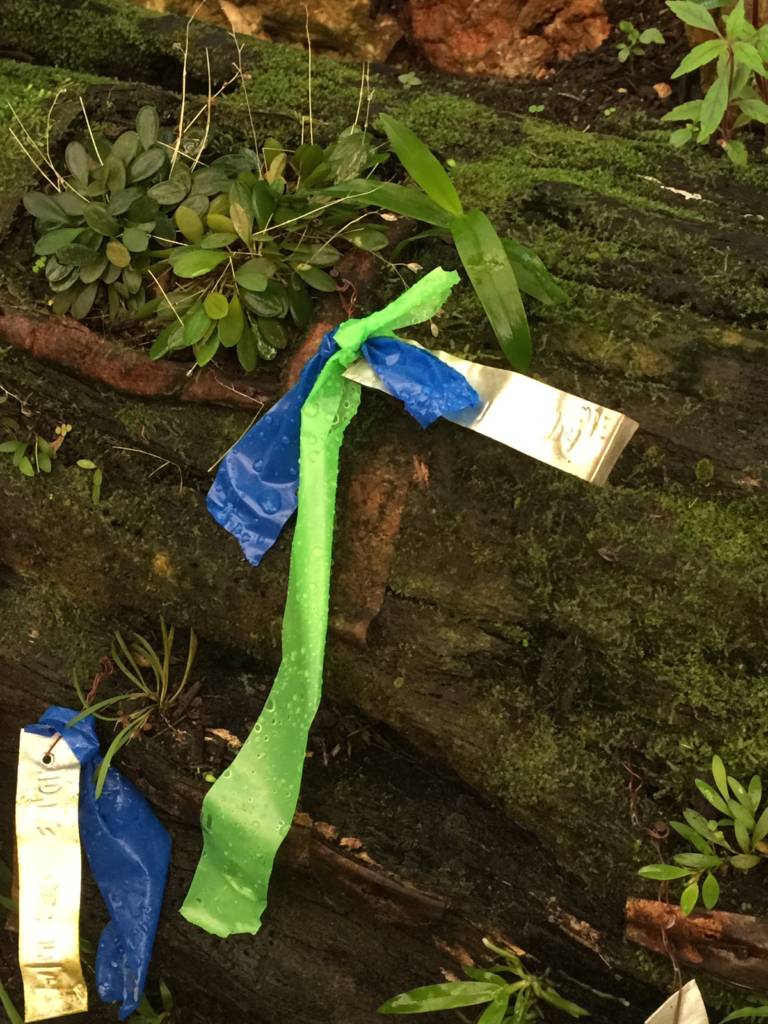
Each specimen is painstakingly marked with a color-coded ribbon or metal tags indicating if they are in bloom, about to bloom, need to be send to another botanic collection site, need to be photographed and recorded, or have been collected on an expedition.

This garden map shows the same care and precision that guides Ella’s tamandua rehabilitation work.

The garden staff examine the specimens every day. Soon after this photo was taken, Ella pointed out to David one specimen about to bloom and said, “It will be spectacular.”

Tonight the staff has secured all of the fragile specimens in anticipation of the hurricane headed our way (the rest of the lodge is also prepared, of course). Abe doesn’t seem to notice, though she did eat an especially large breakfast. Ella theorizes that she was filling her belly before the storm, as she would do in the wild.

Shelter From the Storm in Belize

my shelter

Here I am on Jungle Planet to experience the rescue, rehabilitation, and release of anteaters (known as tamanduas in these parts)! The drama of a long delay in Miami was heightened by the news that Tropical Storm Earl is heading straight for Belize. Time will tell—it’s pouring at the moment. So far, Belize feels part Caribbean and part Central American.

The lovely tamandua rescuer and rehabilitator Ella Baron picked me up in her truck at the small airport in Belize City. Turns out I got luckier than I’d felt in Miami and mine was the last flight in. Ella drove us the 1.5 hours (we gabbed gabbed gabbed the whole way) to Caves Branch Jungle Lodge, my home for the next week, and the site of Tamandua Refuge, Ella’s rescue endeavor. My cabin is “rainforest glamping” style and I woke up to this trippy green panorama:

glamppano

The next morning began with an amazing breakfast, which included two new tastes: breadfruit and mammy fruit. Breadfruit tastes a little like yucca or cassava:

breadfruit

The first order of wildlife-rescue business was a short drive to hunt and gather termite nests for the tamandua’s meals. More on that later—that adventure truly deserves its own post. A teaser: it involved machetes!

After lunch, as the resident tamandua snoozed, Ella gave me a detailed stage-by-stage tour of the seven enclosures in which they stay during their rehabilitation process. Each is designed to meet their individual needs—their size, whether or not they are injured, if they can climb (and if so, how high), and so on. Here are just a few of them. They are each custom-made or adjusted for each animal, which requires Ella’s and her staff’s constant ingenuity and improvisation.

dog carrier

A large dog carrier with a safe climbing area. That figure on the left side of the top shelf is a stuffed tamandua, obvs. The babies actually like to cling to these stuffed animals and squeeze them repeatedly with their paws/claws, sometimes two at a time. Sort of like a cat “kneading.” They also do this to Ella’s hands!


This plexiglass area is for when the tamandua is ready for a little more movement and climbing.

This plexiglass area is for when the tamandua is ready for a little more movement and open space. The logs and branches are kept low for the safest climbing opportunities.

This "jungle gym" is for when the tamandua is nearly ready for the final outdoor enclosure. Safe climbing opportunities abound.

This “jungle gym” is for when the tamandua are nearly ready for the final outdoor enclosure. Safe climbing opportunities abound. Abe (pronounced “Abby”), the female tamandua that is now sleeping in here, will hopefully be released several hours away in the next few weeks, most likely by the usual team: Ella, Don Luis, and Junior.

This is as close to the actual jungle as it gets for about-to-be-wild tamandua.

This is as close to the actual jungle as it gets for about-to-be-wild tamandua. The darkness simulates the rainforest canopy and the trees and plants are all the same as their release sites. It’s more fabulous than this photo shows.

Pinky Protection

pinky

[Photo credit: Wildlife Victoria]

Wombat joeys are called pinkies, for obvious reasons. Recently, this little guy was found in his mum’s pouch after a road accident. Soon after, the good people of Wildlife Victoria stepped in to do right by him. He’ll be bottle-fed hourly, massaged with mineral oil, and kept in a warm cloth pouch. My fantasy: this photo is a book cover and I am the editor of the book. I get to choose the title and subtitle:

  • Wombat Dreams: Australian Habitat Conservation and Wildlife Protection
  • In Our Hands: Holding the Promise of a Better World for Wildlife
  • The Story’s Not Written Yet: Life, Love, and Loss in Wildlife Rehabilitation
  • Life Finds a Way: The Fierce Hope of Wildlife Carers