Today’s Special: Homemade Cat Food

blender

We have two cats, both 15-pounders. That’s a lot of cat food each day. They’re carnivores, of course, so we don’t have a choice about feeding them meat (cats don’t have the enzymatic pathways necessary to get nutrition from plants). But I don’t want to buy any food, for my cats or myself, made from badly-treated animals. So now what? Do we start making our own cat food?

I didn’t face this dilemma until today because, frankly, I thought it would be too hard to do the right thing. This morning, though, I decided to at least do the research, no commitments.

A search on “homemade cat food” turned up a daunting, step-by-step description (Raw Cat Food Diet Recipe Made With Real Bones) of how to procure and then grind organ meats, muscle, bone, gizzards and the like (theoretically great, because why not use all parts of an animal?). The biggest obstacle was the $185 meat grinder–quite an investment if this just wound up being a one-time experiment. But then–duh!–I realized that this grisly prescription was for a raw diet (which has some hardcore proponents and also makes perfect sense, given that the cats’ natural diet is raw).

Another quick search led me to a totally manageable recipe for cooked cat food: gentle combinations of protein, vegetables, and whole grains. Huge sigh of relief. Basically, it’s two cat food recipes that you rotate. Both add up to simply throwing a few ingredients in a blender. Recipe #1 is cooked ground chicken (the Murray’s brand from the co-op is Certified Humane), brown rice, and carrots. Recipe #2 is cooked beef[ref]Michael has found a local source for third-party certified beef; I’ll share all our sources once we compile a master list.[/ref], oats, eggs, and assorted vitamin supplements. You can make big batches and freeze them. I’m going to call the vet first to make sure they’re legit (she thinks I’m crazy anyway).

Our cats, Marvin and Reuben

Marvin and Reuben patiently waiting for us to do the right thing

So that’s our plan moving forward. I take some comfort in knowing that the horrible food I’ve been buying has at least provided one of them, Marvin, with the energy to do something pretty amazing in the world.

Before we adopted him, I knew I wanted to do “pet therapy”–that is, I wanted to visit a nursing home with my cat for what is known in the animal-assisted therapy world as “meet and greets.” I searched and searched for an affectionate, gentle, unflappable cat that didn’t mind traveling in a cat carrier. After a rigorous “Pet Partner” certification process, Marvin and I began our visits, which consist of him laying on a towel on residents’ beds or laps, providing an armful or lapful of love. Every muscle in his body is relaxed as he brings comfort, surprise, and delight with his purrs. Even residents who are agitated or unhappy when we arrive often shift gears when they start to pet Marvin. It’s that whole human-animal bond, a shortcut to their hearts.

Sometimes I hand the residents a brush so they can groom him (it must be nice, when one is constantly being cared for, to be asked to groom an appreciative cat). Sometimes the residents don’t talk with me, but only with Marvin, telling him how handsome he is, or, frequently, how they once had a cat like him. At those times it’s an honor to step back and let him do his work.

Marvin and I will continue our visits no matter what he eats. In fact, we had a great visit just yesterday after I fed him his Science Diet canned food. But today is a new day, so I’ll soon be making the cat equivalent of homemade baby food.

Update 3/19/10: The first batch (the chicken recipe) was easy to make and a big hit! I used boneless chicken thighs, which are much less expensive than breasts. The result looks like chicken salad pudding.

Update 4/10/10: Our cat’s veterinarian, Julie Morris, was very supportive of my DIY approach. At her suggestion I bought Dr. Pitcairn’s Complete Guide to Natural Health for Dogs & Cats. Evidently, Pitcairn is the go-to guy for homemade cat food. All of his recipes include “Healthy Powder”–a mix of bonemeal, kelp powder, vitamin C, nutritional yeast, and lecithin, all of which are available at our co-op. I’ve since made three recipes: Beefy Oats, Poultry Delight, and Feline Feast. The cats love them all. Recently Michael confessed to having tried Beefy Oats. He said it was like dry meatloaf–not exactly tasty, but fine in a pitch.

Blossoming

The Road to Release

I wrote this before Hurricane Earl had its way with Caves Branch. I’ll write more about that experience soon, but first I want to catch up on my account of this trip.


After almost 10 weeks at Tamandua Refuge, Abe (pronounced “Abby”), the resident young tamandua who had been attacked by dogs, is almost ready for release. (Tamanduas are a genus of anteaters; Abe is a Northern Tamanudua.)

Abe had a pin put in to fix her paw.

Ella monitors her behavior with great patience and attention to detail. Abe is currently in the large indoor enclosure; she will skip the final outdoor enclosure and go right to the wild, because she already possesses the requisite wild instinct.

Abe’s surgery, photo by Maritza Navarro

Abe before she was transferred to the current enclosure, munching her termite nest.

Ella holding Abe, photo by Maritza Navarro


This current enclosure is like a tamandua jungle gym: ropes and branches on which she can climb, hang upside down, and twist, reach, and contort herself as she likes, especially for food.

Abe’s current enclosure, the “jungle gym.” Safe climbing opportunities abound.

This morning I observed her eating her breakfast of avocado and termites from the mound (she was also offered a seedy bright magenta fruit called pitaya, but she only destroyed it with her giant claws, as if to say, “I don’t even want to look at this”). She nibbled the avocado and got it all over the tip of her long nose as she made lip-smacking, snuffle-like sounds. Then she moved on and leaned into the termite mound, which is presented in a plastic bin. She flicked her long, thin tongue into the termite nest, which looks like a hard, rocky sponge but is actually made of termite spit and poop.

These are the termites we gathered from the citrus grove the morning after I arrived. Fortunately they’re to Abe’s liking (she’s picky; they all are).

Abe was all worked up in the enclosure for awhile, possibly trying to engage Ella in play. She also up-ended her water bowl and eventually went back into her “bin” to methodically clean herself and have another long snooze. Tamanduas will literally climb the walls (and doors). They’ll find or make a tiny hole and make a break for it. The climbing instinct, and the eventual call of the wild, is that strong. She’s not only ready to bloom, she’s ready to bust out. So Ella has to balance caring for her with dehabituating her to human contact (Abe knows Ella’s smell but no one else’s, so I was a distraction and kept a safe distance).

This “jungle bin” is meant to replicate the choices she will have in the wild, including fermented fruit.

Previous gobbling.


After our human breakfast (no avocado for us), Ella and I walked in the botanical garden that Ella manages with a staff of six (so far I have met Marvin, David, Don Luis, and Junior).

The garden is a marvel. Ella is a botanist and has the largest botanical collection in Belize, including a species she discovered.

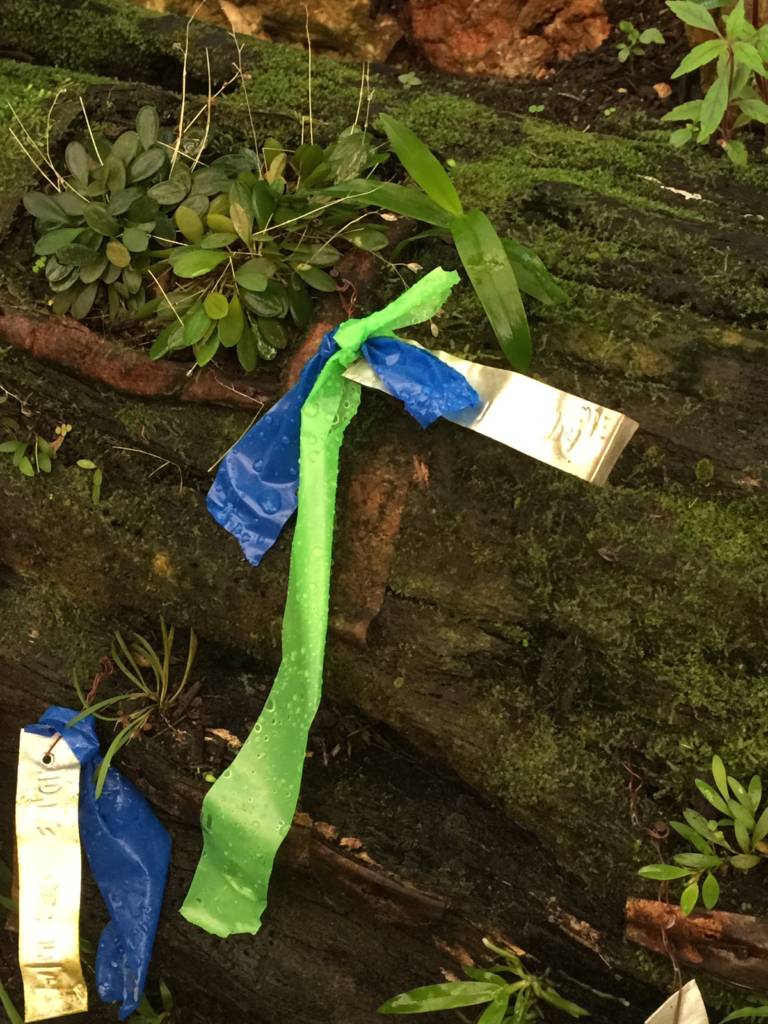
Each specimen is painstakingly marked with a color-coded ribbon or metal tags indicating if they are in bloom, about to bloom, need to be send to another botanic collection site, need to be photographed and recorded, or have been collected on an expedition.

This garden map shows the same care and precision that guides Ella’s tamandua rehabilitation work.

The garden staff examine the specimens every day. Soon after this photo was taken, Ella pointed out to David one specimen about to bloom and said, “It will be spectacular.”

Tonight the staff has secured all of the fragile specimens in anticipation of the hurricane headed our way (the rest of the lodge is also prepared, of course). Abe doesn’t seem to notice, though she did eat an especially large breakfast. Ella theorizes that she was filling her belly before the storm, as she would do in the wild.

Shelter From the Storm in Belize

my shelter

Here I am on Jungle Planet to experience the rescue, rehabilitation, and release of anteaters (known as tamanduas in these parts)! The drama of a long delay in Miami was heightened by the news that Tropical Storm Earl is heading straight for Belize. Time will tell—it’s pouring at the moment. So far, Belize feels part Caribbean and part Central American.

The lovely tamandua rescuer and rehabilitator Ella Baron picked me up in her truck at the small airport in Belize City. Turns out I got luckier than I’d felt in Miami and mine was the last flight in. Ella drove us the 1.5 hours (we gabbed gabbed gabbed the whole way) to Caves Branch Jungle Lodge, my home for the next week, and the site of Tamandua Refuge, Ella’s rescue endeavor. My cabin is “rainforest glamping” style and I woke up to this trippy green panorama:

glamppano

The next morning began with an amazing breakfast, which included two new tastes: breadfruit and mammy fruit. Breadfruit tastes a little like yucca or cassava:

breadfruit

The first order of wildlife-rescue business was a short drive to hunt and gather termite nests for the tamandua’s meals. More on that later—that adventure truly deserves its own post. A teaser: it involved machetes!

After lunch, as the resident tamandua snoozed, Ella gave me a detailed stage-by-stage tour of the seven enclosures in which they stay during their rehabilitation process. Each is designed to meet their individual needs—their size, whether or not they are injured, if they can climb (and if so, how high), and so on. Here are just a few of them. They are each custom-made or adjusted for each animal, which requires Ella’s and her staff’s constant ingenuity and improvisation.

dog carrier

A large dog carrier with a safe climbing area. That figure on the left side of the top shelf is a stuffed tamandua, obvs. The babies actually like to cling to these stuffed animals and squeeze them repeatedly with their paws/claws, sometimes two at a time. Sort of like a cat “kneading.” They also do this to Ella’s hands!


This plexiglass area is for when the tamandua is ready for a little more movement and climbing.

This plexiglass area is for when the tamandua is ready for a little more movement and open space. The logs and branches are kept low for the safest climbing opportunities.

This "jungle gym" is for when the tamandua is nearly ready for the final outdoor enclosure. Safe climbing opportunities abound.

This “jungle gym” is for when the tamandua are nearly ready for the final outdoor enclosure. Safe climbing opportunities abound. Abe (pronounced “Abby”), the female tamandua that is now sleeping in here, will hopefully be released several hours away in the next few weeks, most likely by the usual team: Ella, Don Luis, and Junior.

This is as close to the actual jungle as it gets for about-to-be-wild tamandua.

This is as close to the actual jungle as it gets for about-to-be-wild tamandua. The darkness simulates the rainforest canopy and the trees and plants are all the same as their release sites. It’s more fabulous than this photo shows.

Pinky Protection

pinky

[Photo credit: Wildlife Victoria]

Wombat joeys are called pinkies, for obvious reasons. Recently, this little guy was found in his mum’s pouch after a road accident. Soon after, the good people of Wildlife Victoria stepped in to do right by him. He’ll be bottle-fed hourly, massaged with mineral oil, and kept in a warm cloth pouch. My fantasy: this photo is a book cover and I am the editor of the book. I get to choose the title and subtitle:

  • Wombat Dreams: Australian Habitat Conservation and Wildlife Protection
  • In Our Hands: Holding the Promise of a Better World for Wildlife
  • The Story’s Not Written Yet: Life, Love, and Loss in Wildlife Rehabilitation
  • Life Finds a Way: The Fierce Hope of Wildlife Carers